
UoN Hosts Africa Forward Summit Focused on Youth, AI and Innovation
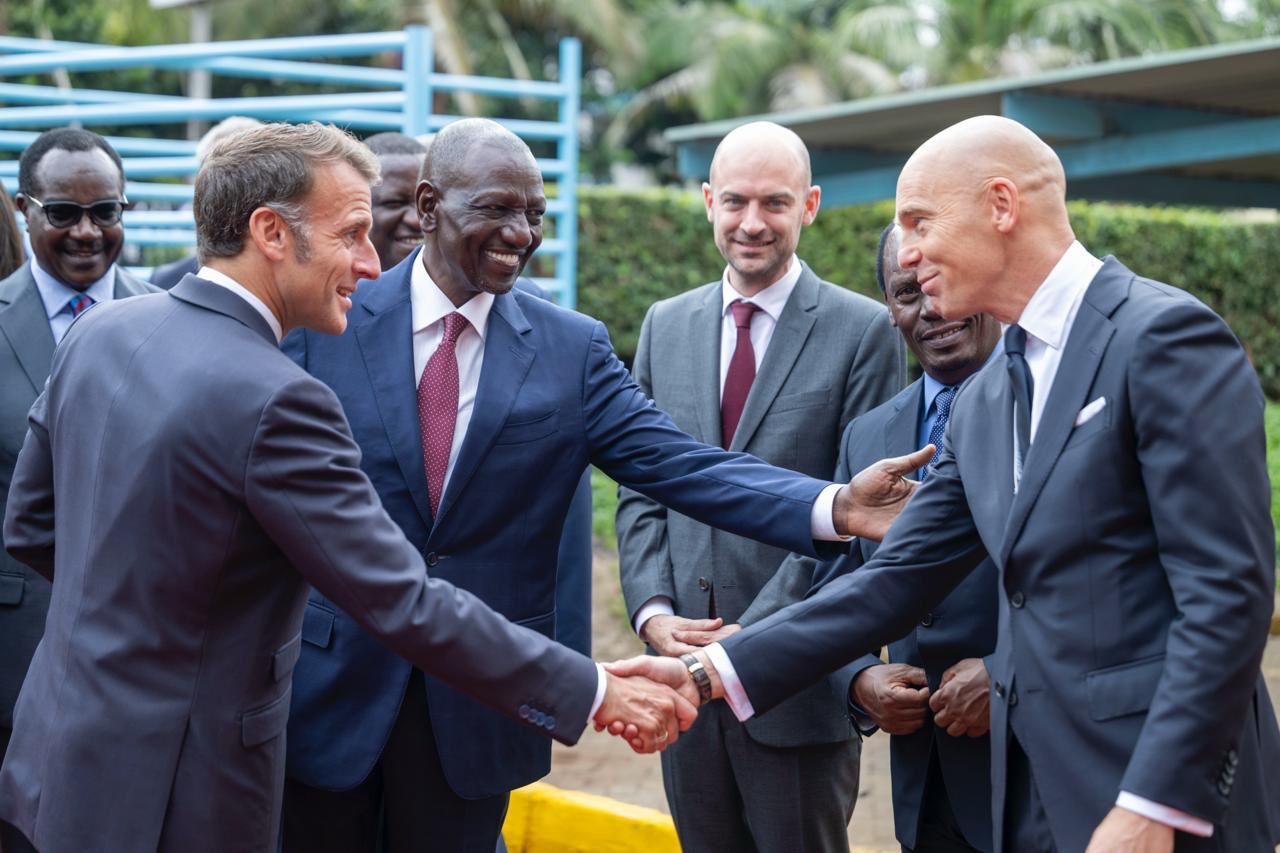
A powerful message resonated throughout the University of Nairobi on Monday: Africa’s economic future will depend on how effectively the continent transforms its youthful population into skilled innovators, entrepreneurs, and job creators.
This vision shaped the inaugural Africa Forward Summit, which brought together Heads of State, global partners, innovators, scholars, and students for a series of highlevel discussions on artificial intelligence, education reform, sports development, and industrial innovation.
The summit, co-hosted by Their Excellencies President Dr. William Ruto and French President Emmanuel Macron, marked President Macron’s second engagement with the University since 2019. His return renewed international attention on the Engineering and Science Complex (ESC), a flagship infrastructure and innovation project supported by the Government of France through Agence Française de Développement.
At the University foyer, Presidents Ruto and Macron were presented with the architectural model of the Engineering and Science Complex, a development positioned as a long-term solution to Africa’s skills, research, and industrialization challenges.
Vice-Chancellor Prof. Margaret Hutchinson described the ESC as a transformative initiative redefining the relationship between higher education, research, and economic development.
She noted that the ESC is designed to integrate education, research, industry, and innovation into a unified ecosystem capable of generating employment and accelerating innovation at scale.
“The ESC is a transformative step towards bridging education, research, industry and innovation to create jobs, jobs, jobs,” she said.
Prof. Hutchinson explained that the 30,000-square-metre facility at Chiromo Campus will host eight interconnected centres of excellence focused on Artificial Intelligence, Data Science, Energy, Agriculture, Health Technologies, and Advanced Manufacturing.
She emphasized that the initiative extends beyond Kenya’s national ambitions.
“This is not just for Nairobi or Kenya. It is a prototype for Africa,” she stated.
President Ruto observed that Africa’s greatest challenge remains converting its vast human capital into productive economic participation.
“Africa’s greatest resource is not beneath the ground; it is the talent, creativity and energy of its young people,” he said.
President Macron underscored the importance of stronger Africa-Europe partnerships in shaping the future of global innovation, particularly in artificial intelligence and digital infrastructure.
“We must build partnerships based on cocreation and shared opportunity,” he noted.
At Taifa Hall, the Future Makers Youth Forum and Conversations on Artificial Intelligence convened students, innovators, policymakers, and development partners for candid discussions on Africa’s labour market and the future of work.
The forum explored how artificial intelligence, digital skills, and entrepreneurship can help address youth unemployment while preparing graduates for rapidly evolving global industries.
University Chancellor Prof. Patrick Verkooijen delivered one of the summit’s most compelling reflections, highlighting the scale of the employment challenge facing the continent.
“Every month across Africa, one million young people enter the job market, yet only a quarter secure employment,” he said.
He warned that without urgent reforms in education and innovation systems, the gap between skills acquisition and employment opportunities would continue to widen.
“We must bridge education, research, industry and innovation to create jobs at scale,” he added. “The ESC is not just infrastructure it is an African prototype for solving unemployment through innovation.”
President Ruto called upon universities to redesign training systems around emerging industries, while President Macron advocated for deeper Africa-Europe cooperation in artificial intelligence, noting that Africa’s youthful demographic represents a major global strategic advantage.
Another key highlight was the HighLevel Sports Dialogue held at the Jomo Kenyatta Memorial Library, where discussions focused on sports as a driver of economic growth and social development.
President Ruto and President Macron were joined by Botswana President Duma Boko and Senegal President Bassirou Diomaye Faye, alongside other African leaders attending the summit.
CAF President Patrice Motsepe also participated in the discussions, which explored strengthening sports ecosystems, investing in infrastructure, and expanding opportunities for youth through sports.
Leaders emphasized the growing connection between sports, education, innovation, and the creative economy, observing that sports are increasingly becoming structured pathways to employment, enterprise, and social mobility for young people.
President Macron stated that sports, like technology, should be treated as a strategic development sector rather than solely as recreation, while President Ruto emphasized the importance of investing in talent systems that connect education with opportunity.
The summit concluded at Graduation Square, where sports demonstrations showcased student-athletes in basketball and other disciplines in a vibrant display of talent, energy, and youth potential.
Supported through partnerships involving the NBA and other sports development stakeholders, the activities transformed the venue into a public celebration of youth capability and sporting excellence.
Across all engagements, one message remained consistent: Africa’s future competitiveness will depend on how successfully it connects education, innovation, sports, and industry into a unified ecosystem of opportunity.
Following the summit, a series of highlevel ministerial engagements between Kenyan and French officials further strengthened academic cooperation and innovation partnerships involving the University of Nairobi.
The discussions reinforced collaboration in higher education, research, and innovation between the University and French institutions, particularly in science, agriculture, energy, and sustainable development.
New cooperation frameworks were strengthened with the University of Mayotte and INRAE — France’s National Research Institute for Agriculture, Food and Environment expanding joint research and academic exchange in agriculture, food systems, and environmental science.
Partnerships with Paris Sciences et Lettres (PSL) also deepened collaboration in science, engineering, and innovation capacity building.
In addition, a new Energy Industrial Chair was advanced, bringing together academic and private-sector partners to strengthen research and training in energy systems and transition technologies.
Further collaboration with AgroParisTech reinforced a shared Africa-France agenda focused on innovation in agriculture and food systems.
These developments further positioned Kenya and the University of Nairobi as an emerging hub for international scientific cooperation, innovation, and youth-centred development.
Throughout the Africa Forward Summit, one central question consistently guided the discussions: how Africa can transform its youthful population into a productive, innovative, and globally competitive workforce.
- Log in to post comments


