
KENYA AND FRANCE REDEFINE STRATEGIC PARTNERSHIP IN A CHANGING GLOBAL LANDSCAPE
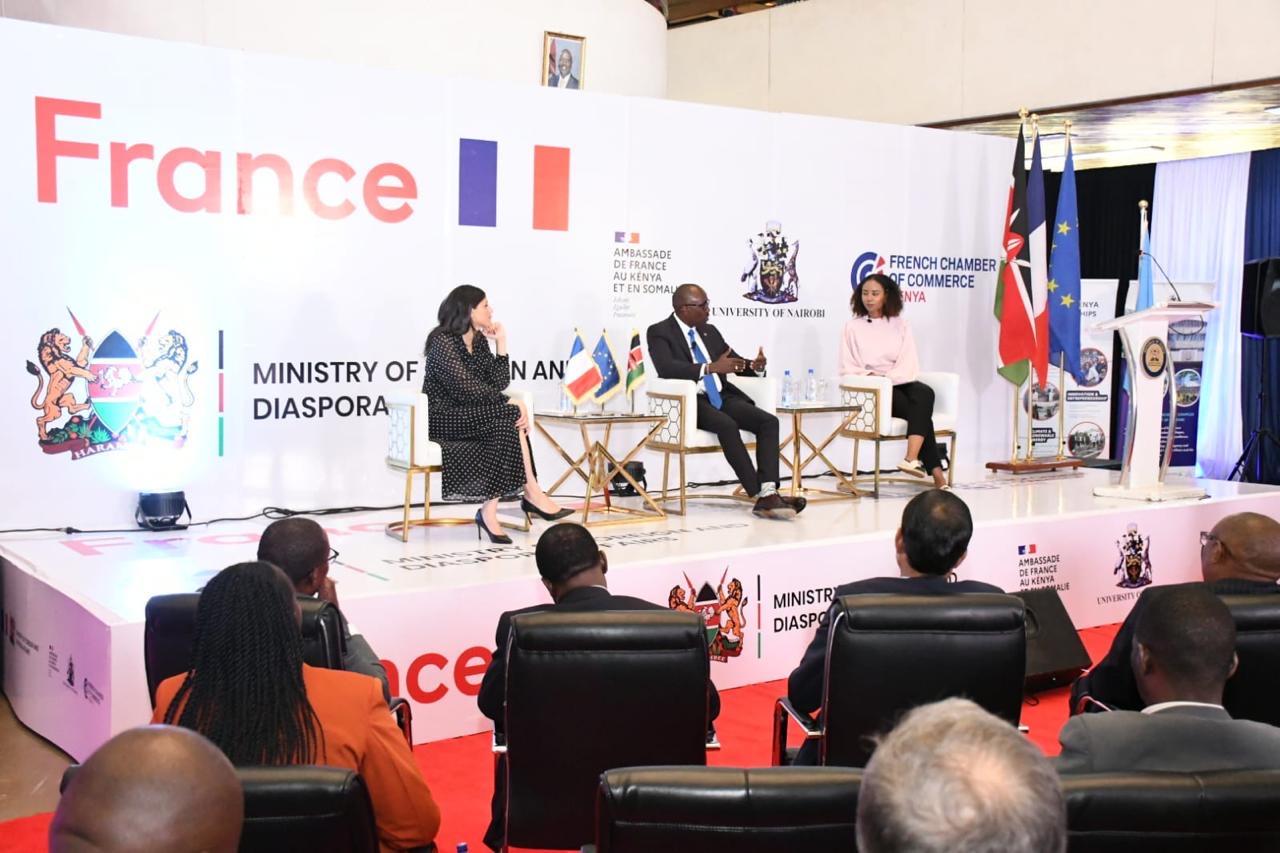
KENYA AND FRANCE STRATEGIC PARTNERSHIP
What defines a strategic partnership at a time when multilateral systems are under pressure, climate challenges are escalating, and global alliances are constantly evolving?
This question anchored a high-level dialogue held at the University of Nairobi’s Jomo Kenyatta Memorial Library on Friday, March 13, 2026. The engagement brought together leaders from Kenya and France to reflect not only on their bilateral relations, but also on the future direction of global diplomacy.
Welcoming participants on behalf of the Vice Chancellor, Deputy Vice Chancellor for Finance, Planning and Development, Prof. Jackson Maalu, set a reflective tone by pointing to the historical significance of the venue. “This place has hosted generations of students, including your Excellency, Principal Secretary welcome back home,” he remarked, prompting light laughter. The moment underscored a deeper connection shared spaces, shared experiences, and shared aspirations.
Prof. Maalu highlighted France as a longstanding and valued academic partner of the University of Nairobi. He noted that collaborations spanning engineering, science, agriculture, business, and social sciences with institutions such as Paris-Saclay, PSL, Sciences Po, Nice Côte d’Azur, and Montpellier are central to the university’s transformation agenda. With support from the French Embassy, Campus France, AFD, and Expertise France, these partnerships continue to demonstrate the value of mutual cooperation. “In a fractured world,” he emphasized, echoing the event’s theme, “such partnerships are not just important they are essential.”
Kenya’s Principal Secretary for Foreign and Diaspora Affairs, Dr. Korir Sing’Oei, reinforced this urgency by situating the discussion within broader global realities. He observed that the international system is facing significant strain, marked by repeated crises, declining solidarity, and weakening multilateral institutions. “No matter how difficult the challenges may be, isolation is not the answer,” he stated. “We must work together and develop more effective, collaborative approaches.” He described the Kenya–France partnership as a model of constructive engagement rooted in shared principles, including respect for international law, sustainable development, education, and youth empowerment.
Minister Delegate for Francophonie and International Partnerships, H.E. Éléonore Caroit, broadened the perspective by positioning Kenya within France’s evolving global outlook. She described Kenya as both a regional anchor in East Africa and a strategic gateway connecting Africa to the Indo-Pacific. With more than 140 French companies operating in Kenya and generating thousands of jobs, she noted that economic ties are already strong. Looking ahead, she identified opportunities to deepen collaboration in climate action, health systems, infrastructure, renewable energy, digital innovation, and the blue economy.
The upcoming Africa Forward Summit, scheduled for May 2026 in Nairobi, emerged as a key focal point of the discussion. Both speakers framed the summit as more than a routine diplomatic gathering, describing it instead as a platform to rethink global financial systems, promote sustainable investment, and amplify African perspectives in global decision-making. Issues such as financial reform, energy transition, digital transformation, and the blue economy are expected to take center stage.
A recurring theme throughout the engagement was the role of youth. Africa’s growing population is not merely a demographic trend it is a strategic force. Minister Caroit encouraged young people to see global uncertainty not only as a challenge, but also as an opportunity for innovation, collaboration, and leadership. The emphasis, she noted, should be on meaningful inclusion ensuring that young people actively shape programs, policies, and international partnerships.
Yet, fundamental questions remain.
Can multilateralism be renewed rather than discarded? Can partnerships evolve to become more equitable and less extractive? Can Africa play a defining role in shaping global governance rather than simply reacting to it?
Within the walls of a library that has shaped generations, these questions felt immediate and consequential. If the global order is indeed shifting, the task ahead is not to restore what once was, but to build something more balanced, inclusive, and resilient for the future.
- Log in to post comments


